



Sube tu fotos y Vídeos
Imágenes | Google image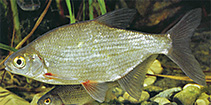 Blicca bjoerkna
Foto de Hartl, A.
Imágenes | Google image
Foto de Hartl, A.
Clasificación / Nombres Nombres comunes | Sinónimos | Catalog of Fishes(Género, Especie) | ITIS | CoL | WoRMS | Cloffa
Entorno: milieu / zona climática / rango de profundidad / gama de distribución Ecología
; agua dulce; salobre demersal; potamodromo (Ref. 51243); rango de profundidad 0 - ? m. Temperate; 4°C - 20°C (Ref. 2059); 65°N - 40°N
Distribución Territorios | Áreas FAO | Ecosistemas | Ocurrencias, apariciones | Mapa de puntos | Introducciones | Faunafri
Europe and Asia: North, Baltic, White, Black (south to Rioni drainage) and Caspian Sea basins, Atlantic basin southward to Adour drainage (France; possibly introduced southward of Loire) and Mediterranean basin in France (Hérault and Rhône drainages). In Aral, Marmara and Anatolian Black Sea basins west of Ankara. Naturally absent from Iberian Peninsula, Italy, Adriatic basin, Crimea, Great Britain (except southeast), Scandinavia north of Sundsvall (Sweden) and 65° N (Finland). Locally introduced in Spain and northeastern Italy; in France, apparently introduced in smal coastal drainages of Var.
Longitud en la primera madurez / Tamaño / Peso / Edad
Madurez: Lm ? range ? - ? cm
Max length : 45.5 cm TL macho / no sexado; (Ref. 88166); common length : 20.0 cm TL macho / no sexado; (Ref. 556); peso máximo publicado: 1.0 kg (Ref. 30578)
Max length : 45.5 cm TL macho / no sexado; (Ref. 88166); common length : 20.0 cm TL macho / no sexado; (Ref. 556); peso máximo publicado: 1.0 kg (Ref. 30578)
Descripción breve Claves de identificación | Morfología | Morfometría
Espinas dorsales (total) : 3; Radios blandos dorsales (total) : 8; Espinas anales: 3; Radios blandos anales: 19 - 22; Vértebra: 39 - 40. The only species of the genus which can be diagnosed from similar species of genera Ballerus, Blicca and Vimba by having the following characters: mouth sub-inferior, which can not be extended as a tube; scales on lateral line 43-46 + 2-3 ; anal fin with 19-23½ branched rays; eye diameter about equal to snout length in individuals larger than 10 cm SL; pharyngeal teeth 2,5-2,5; and orange or reddish base of paired fins (Ref. 59043). Caudal fin with 17-19 rays (Ref. 2196).
Body shape (shape guide): fusiform / normal.
Body shape (shape guide): fusiform / normal.
Gregarious and frequents stagnant waters of lakes and reservoirs, rivers and canals with calm waters. Occurs in a wide variety of shallow, warm lowland lakes and slow-flowing lower reaches of large rivers and canals. Frequently very abundant on bottom of large sandy rivers. Larvae live in still water bodies. Mainly nocturnal. Feeds on benthic invertebrates. Spawns along shores on submerged vegetations, roots or even on shallow gravel bottom (Ref. 59043). Reproduction takes place in May to July. Exhibits polyandry (Ref. 6114). Regularly hybridizes with Vimba vimba (Ref. 59043). Of little interest to game fishers and consumers (Ref. 30578). Unpopular with commercial fishers due to its small size and competition with more desired species.
Ciclo vital y comportamiento de apareamiento Madurez | Reproducción | Puesta | Huevos | Fecundidad | Larva
Exhibits polyandry, with courting tactics developed by males. Trembling and splashing movements signal release of eggs and sperms on plant substratum (Ref. 6114). Eggs are sticky (Ref. 59043).
Referencia principal
Suba sus referencias | Referencias | Coordinador | Colaboradores
Kottelat, M. and J. Freyhof, 2007. Handbook of European freshwater fishes. Publications Kottelat, Cornol and Freyhof, Berlin. 646 pp. (Ref. 59043)
Situación en la Lista Roja de la UICN (Ref. 130435: Version 2025-2 (Global))
Least Concern (LC) ; Date assessed: 27 May 2022
CITES
Not Evaluated
Amenaza para el ser humano
Harmless
Usos humanos
Pesquerías: escaso valor comercial; Acuario: Acuarios públicos; carnada: occasionally
FAO - Sistemas de acuicultura: producción; pesquerías: desembarques; Publication: search | FishSource |
Más información
Ecología Trófica
Alimentos (presas)
Composición de la dieta
consumo de alimento
Raciones de comida
Despredadores
Alimentos (presas)
Composición de la dieta
consumo de alimento
Raciones de comida
Despredadores
Dinámica de la población
Coeficiente del crecimiento para
Edades / tallas máximas
Longitud-peso rel.
Longitud-longitud rel.
Longitud-frecuencias
Conversión de masas
Reclutamiento
Abundancia
Coeficiente del crecimiento para
Edades / tallas máximas
Longitud-peso rel.
Longitud-longitud rel.
Longitud-frecuencias
Conversión de masas
Reclutamiento
Abundancia
Ciclo de vida
Reproducción
Madurez
Madurez/Gills rel.
Fecundidad
Puesta
Agregaciones de desove
Huevos
Desarrollo de los huevos
Larva
Dinámica larvaria
Reproducción
Madurez
Madurez/Gills rel.
Fecundidad
Puesta
Agregaciones de desove
Huevos
Desarrollo de los huevos
Larva
Dinámica larvaria
Distribución
Territorios
Áreas FAO
Ecosistemas
Ocurrencias, apariciones
Introducciones
BRUVS - Vídeos
Territorios
Áreas FAO
Ecosistemas
Ocurrencias, apariciones
Introducciones
BRUVS - Vídeos
Fisiología
Composición corporal
Nutrientes
Consumo del oxígeno
Tipo de natación
Velocidad de natación
Pigmentos visuales
Sonido de peces
Enfermedades y parásitos
Toxicidad (CL50)
Composición corporal
Nutrientes
Consumo del oxígeno
Tipo de natación
Velocidad de natación
Pigmentos visuales
Sonido de peces
Enfermedades y parásitos
Toxicidad (CL50)
Relacionados con el ser humano
Sistemas de acuicultura
Perfiles de acuicultura
Razas
Ciguatera cases
Sellos, monedas, varios
Sistemas de acuicultura
Perfiles de acuicultura
Razas
Ciguatera cases
Sellos, monedas, varios
Herramientas
Libro electrónico | Guía de campo | Claves de identificación | Asistente para frecuencias de tallas | Herramienta de ciclo de vida | Mapa de puntos |
Catch-MSY |
Informes especiales
Comprobar el mantenimiento del acuario | Buscar fichas sobre especies | Consulte las hojas informativas sobre acuicultura
Descargar XML
Fuentes de Internet
AFORO (otoliths) | Alien/Invasive Species database | Aquatic Commons | BHL | Cloffa | Websites from users | Check FishWatcher | CISTI | Catalog of Fishes: Género, Especie | DiscoverLife | ECOTOX | FAO - Sistemas de acuicultura: producción; pesquerías: desembarques; Publication: search | Faunafri | Fishipedia | Fishtrace | GloBI | Google Books | Google Scholar | Google | IGFA World Record | Bases de datos nacionales | OneZoom | Open Tree of Life | Otolith Atlas of Taiwan Fishes | Acuarios públicos | PubMed | Reef Life Survey | Socotra Atlas | TreeBase | Árbol de la vida | Wikipedia: Go, búsqueda | World Records Freshwater Fishing | Expediente Zoológico
Estimaciones basadas en modelos
Índice de diversidad filogenética (Referencia 82804): PD50 = 1.0000 [Uniqueness, from 0.5 = low to 2.0 = high].
Bayesian length-weight: a=0.00741 (0.00667 - 0.00824), b=3.15 (3.12 - 3.18), in cm total length, based on LWR estimates for this species (Ref. 93245).
Nivel trófico (Referencia 69278): 3.2 ±0.0 se; based on diet studies.
Resiliencia (Referencia 120179): Medio, población duplicada en un tiempo mínimo de 1.4-4.4 años (K=0.10-0.27; tm=3-4).
Nutrientes (Ref. 124155): Calcium = 66.8 [32.4, 112.3] mg/100g; Iron = 0.407 [0.243, 0.722] mg/100g; Protein = 17.7 [16.1, 19.1] %; Omega3 = 0.605 [0.278, 1.290] g/100g; Selenium = 7.59 [3.59, 16.22] μg/100g; VitaminA = 19.1 [6.1, 60.6] μg/100g; Zinc = 0.826 [0.581, 1.185] mg/100g (wet weight);