



muatnaik fotos/gambar dan video
Gambar | imej Google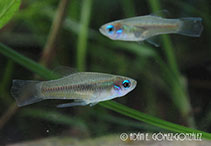 Priapella chamulae
Male foto/gambar oleh Gómez González, A.E.
Gambar | imej Google
Male foto/gambar oleh Gómez González, A.E.
klasifikasi / Nama Nama-nama umum | Sinonim (persamaan) | Catalog of Fishes(Marga, Jenis) | ITIS | CoL | WoRMS | Cloffa
> Cyprinodontiformes (Rivulines, killifishes and live bearers) > Poeciliidae (Poeciliids) > Poeciliinae
Etymology: Priapella: Taken from Priapus, the Greek, and Roman god of procreation in the mithology and also = a phallus; diminutive (Ref. 45335); chamulae: Named for the native population of the Chamula, who live in central Chiapas and on the Tabasco border, Mexico.
Eponymy: This is not a true eponym as it is after Priapus, the Greek god of fertility. [...] Not a true eponym but named for a people; the native population of the Chamula, who live in central Chiapas and on the Tabasco border, Mexico. An amphibian is also named after them. (Ref. 128868), visit book page.
Etymology: Priapella: Taken from Priapus, the Greek, and Roman god of procreation in the mithology and also = a phallus; diminutive (Ref. 45335); chamulae: Named for the native population of the Chamula, who live in central Chiapas and on the Tabasco border, Mexico.
Eponymy: This is not a true eponym as it is after Priapus, the Greek god of fertility. [...] Not a true eponym but named for a people; the native population of the Chamula, who live in central Chiapas and on the Tabasco border, Mexico. An amphibian is also named after them. (Ref. 128868), visit book page.
Lingkungan: lingkungan / zona iklim / kisaran kedalaman / jangkauan distribusi Ekologi
; air tawar dasar (demersal). Tropical
Penyebaran Wilayah | Daerah-daerah FAO | Ekosistem | Kemunculan | peta titik | Introduksi | Faunafri
North America: Mexico.
Ukuran / Berat / umur
deskripsi pendek Kunci identifiaksi (pengenalan) | Morfologi | Morfometrik
duri punggung lunak (Keseluruhan (total)) : 9 - 10; Sirip dubur lunak: 10; vertebrata, bertulang belakang: 30 - 31. This species is a large sized species of Priapella (maximum length 4.8 cm SL). It is distinguished from its congeners by having the following characters: a membranous hook of the gonopodium ray 3 well developed and semicircularly bent (vs. slightly bent in P. bonita, P. compressa, P. intermedia and P. olmecae); subdistal plate-like membranous process on gonopodium ray 3 well developed (vs. not prominent in P. compressa and P. intermedia); spines of gonopodium ray 3 long and not numerous (vs. numerous and densely crowded in P. compressa and P. intermedia) and short and not densely crowed in P. olmecae); distal part of gonopodium ray 4p slightly bent (vs. strongly bent in P. bonita, P. compressa, P. intermedia and P. olmecae). This species is also distinguished by having a short gonopodium; frequency distribution of SL/GL radius 3.30-3.50 (vs. 2.60-2.75 in P. olmecae, 3.00-3.20 in P. compressa, 2.60 in P. bonita and 3.50-3.60 in P. intermedia; gill rakers 10-12 (vs. 15-16 in P. bonita, 120-13 in P. compressa, 12-14 in P. compressa; dorsal-fin rays 9 (vs. 8 in P. bonita, 10 in P. compressa (Ref. 57748).
Collected from a small brook, about 0.5 to 1 m wide, that flows into a tributary to the río Tacotalpa, close to a bridge, a few hundred meters on an unpaved road that branches off into northeasterly direction from the main road from Tapijulapa to Jamapa between the small settlements of Zunu y Patastal and Madrigal (Cuarta sección). At the time of collection, at late afternoon the water had a temperature of 26 °C, a conductivity of 360 mS, pH 8.0, and total hardness of 10-15. The water was crystal clear and fast flowing with no aquatic vegetation. The substratum consisted mainly of gravel and sand. The brook flows in a deep indentation and is fully shadowed by the vegetation. Associated poeciliid fishes were Pseudoxiphophorus bimaculatus, Gambusia sp., Heterophallus milleri, Poecilia mexicana and a characid, Astyanax mexicanus (Ref. 57748).
Siklus hidup dan perilaku kawin Kematangan | Reproduksi, perkembang biakan | Pemijahan | telur-telur | Fekunditas | Larva
rujukan utama
Unggah referensi Anda | Acuan | Koordinator | mitra
Schartl, M., M.K. Meyer and B. Wilde, 2006. Description of Priapella chamula sp. n. - a new poeciliid fish from the upper rio Grijalva system, Tabasco, Mexico (Teleostei: Cyprinodontiformes: Poeciliidae). Zoologische Abhandlung (Dresden) 55:59-67. (Ref. 57748)
Status IUCN Red List (Ref. 130435: Version 2025-2 (Global))
kekurangan data (DD) ; Date assessed: 27 March 2018
CITES
Not Evaluated
ancaman kepada manusia
Harmless
penggunaan manusia
Perikanan: tidak ada kepentingan
FAO - Publication: search | FishSource |
informasi lanjut
Ekologi trofik
Item makanan (mangsa)
Komposisi makanan
Konsumsi makanan
Ransum makanan
Pemangsa
Item makanan (mangsa)
Komposisi makanan
Konsumsi makanan
Ransum makanan
Pemangsa
Dinamika populasi
Parameter pertumbuhan
Maks. usia / ukuran
Panjang-berat rel.
Panjang-panjang rel.
ukuran frekuensi
Konversi massa
pemulihan
Kelimpahan
Parameter pertumbuhan
Maks. usia / ukuran
Panjang-berat rel.
Panjang-panjang rel.
ukuran frekuensi
Konversi massa
pemulihan
Kelimpahan
Siklus hidup
Reproduksi, perkembang biakan
Kematangan
Kedewasaan / insang rel.
Fekunditas
Pemijahan
Agregasi pemijahan
telur-telur
pekembangan telor
Larva
Dinamika larva
Reproduksi, perkembang biakan
Kematangan
Kedewasaan / insang rel.
Fekunditas
Pemijahan
Agregasi pemijahan
telur-telur
pekembangan telor
Larva
Dinamika larva
Anatomi
Area insang
Otak
Otolith
Area insang
Otak
Otolith
Fisiologi
Komposisi tubuh
Nutrisi
Konsumsi oksigen
Jenis renang
Kecepatan berenang
Pigmen visual
Suara ikan
Penyakit & Parasit
Toksisitas (LC50)
Komposisi tubuh
Nutrisi
Konsumsi oksigen
Jenis renang
Kecepatan berenang
Pigmen visual
Suara ikan
Penyakit & Parasit
Toksisitas (LC50)
Genetika
genom
Genetika
Heterozigositas
Diturunkan
Keanekaragaman Genetik
genom
Genetika
Heterozigositas
Diturunkan
Keanekaragaman Genetik
Yang berhubungan dengan manusia
Sistem akuakultur
profil budidaya air
Strain
Kasus Ciguatera
Perangko, koin, dll.
Sistem akuakultur
profil budidaya air
Strain
Kasus Ciguatera
Perangko, koin, dll.
Alat, peralatan
E-book | Penuntun lapangan | tanda freqkuenci panjang | peringkat sejarah hidup | peta titik |
Tangkap-MSY |
laporan khas
muat turun XML
Sumber internet
AFORO (otoliths) | Aquatic Commons | BHL | Cloffa | Websites from users | semak peneliti ikan | CISTI | Catalog of Fishes: Marga, Jenis | DiscoverLife | ECOTOX | FAO - Publication: search | Faunafri | Fishipedia | Fishtrace | GloBI | Google Books | Google Scholar | Google | IGFA World Record | OneZoom | Open Tree of Life | Otolith Atlas of Taiwan Fishes | PubMed | Reef Life Survey | Socotra Atlas | TreeBase | Tree of Life | Wikipedia: pergi, Cari | World Records Freshwater Fishing | Zoobank | Catatan Zoologi
Estimasi berdasarkan model
Indeks keanekaragaman filogenetik (Acuan 82804): PD50 = 0.5156 [Uniqueness, from 0.5 = low to 2.0 = high].
Bayesian length-weight: a=0.00851 (0.00369 - 0.01962), b=3.15 (2.96 - 3.34), in cm total length, based on LWR estimates for this (Sub)family-body shape (Ref. 93245).
Tingkat Trofik (Acuan 69278): 3.0 ±0.4 se; based on size and trophs of closest relatives
Daya lenting (Acuan 120179): Tinggi, Waktu penggandaan populasi minimum kurang dari 15 bulan (Preliminary K or Fecundity.).