



アップロード 写真 そして ビデオ
画像 | グーグルの画像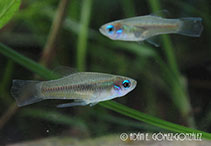 Priapella chamulae
Male 画像によって Gómez González, A.E.
画像 | グーグルの画像
Male 画像によって Gómez González, A.E.
分類 / 名前 共通名の | 類義語 | Catalog of Fishes(部類, 種) | ITIS | CoL | WoRMS | Cloffa
> Cyprinodontiformes (Rivulines, killifishes and live bearers) > Poeciliidae (Poeciliids) > Poeciliinae
Etymology: Priapella: Taken from Priapus, the Greek, and Roman god of procreation in the mithology and also = a phallus; diminutive (Ref. 45335); chamulae: Named for the native population of the Chamula, who live in central Chiapas and on the Tabasco border, Mexico.
Eponymy: This is not a true eponym as it is after Priapus, the Greek god of fertility. [...] Not a true eponym but named for a people; the native population of the Chamula, who live in central Chiapas and on the Tabasco border, Mexico. An amphibian is also named after them. (Ref. 128868), visit book page.
Etymology: Priapella: Taken from Priapus, the Greek, and Roman god of procreation in the mithology and also = a phallus; diminutive (Ref. 45335); chamulae: Named for the native population of the Chamula, who live in central Chiapas and on the Tabasco border, Mexico.
Eponymy: This is not a true eponym as it is after Priapus, the Greek god of fertility. [...] Not a true eponym but named for a people; the native population of the Chamula, who live in central Chiapas and on the Tabasco border, Mexico. An amphibian is also named after them. (Ref. 128868), visit book page.
環境:環境 / 気候帯 / 深さの範囲 / 分布範囲 生態学
; 新鮮な水 底生の. Tropical
分布 領土 | 国連食糧農業機関の区域 | エコシステム | 事件 | 目的のマップ | 導入 | Faunafri
North America: Mexico.
サイズ / 重さ / 年齢
簡単な記述 検索表 | 形態学 | 形態計測学
背鰭 (合計) : 9 - 10; 臀鰭: 10; 脊つい: 30 - 31. This species is a large sized species of Priapella (maximum length 4.8 cm SL). It is distinguished from its congeners by having the following characters: a membranous hook of the gonopodium ray 3 well developed and semicircularly bent (vs. slightly bent in P. bonita, P. compressa, P. intermedia and P. olmecae); subdistal plate-like membranous process on gonopodium ray 3 well developed (vs. not prominent in P. compressa and P. intermedia); spines of gonopodium ray 3 long and not numerous (vs. numerous and densely crowded in P. compressa and P. intermedia) and short and not densely crowed in P. olmecae); distal part of gonopodium ray 4p slightly bent (vs. strongly bent in P. bonita, P. compressa, P. intermedia and P. olmecae). This species is also distinguished by having a short gonopodium; frequency distribution of SL/GL radius 3.30-3.50 (vs. 2.60-2.75 in P. olmecae, 3.00-3.20 in P. compressa, 2.60 in P. bonita and 3.50-3.60 in P. intermedia; gill rakers 10-12 (vs. 15-16 in P. bonita, 120-13 in P. compressa, 12-14 in P. compressa; dorsal-fin rays 9 (vs. 8 in P. bonita, 10 in P. compressa (Ref. 57748).
Collected from a small brook, about 0.5 to 1 m wide, that flows into a tributary to the río Tacotalpa, close to a bridge, a few hundred meters on an unpaved road that branches off into northeasterly direction from the main road from Tapijulapa to Jamapa between the small settlements of Zunu y Patastal and Madrigal (Cuarta sección). At the time of collection, at late afternoon the water had a temperature of 26 °C, a conductivity of 360 mS, pH 8.0, and total hardness of 10-15. The water was crystal clear and fast flowing with no aquatic vegetation. The substratum consisted mainly of gravel and sand. The brook flows in a deep indentation and is fully shadowed by the vegetation. Associated poeciliid fishes were Pseudoxiphophorus bimaculatus, Gambusia sp., Heterophallus milleri, Poecilia mexicana and a characid, Astyanax mexicanus (Ref. 57748).
ライフサイクルと交尾行動 成熟 | 繁殖 | 放精 | 卵 | 生産力 | 幼生
主な参考文献
参考文献のアップロード | 参考文献 | コーディネーター | 協力者
Schartl, M., M.K. Meyer and B. Wilde, 2006. Description of Priapella chamula sp. n. - a new poeciliid fish from the upper rio Grijalva system, Tabasco, Mexico (Teleostei: Cyprinodontiformes: Poeciliidae). Zoologische Abhandlung (Dresden) 55:59-67. (Ref. 57748)
CITES
Not Evaluated
人間に対する脅威
Harmless
人間の用途
水産業: 興味がない
FAO - Publication: search | FishSource |
より多くの情報
ライフサイクル
繁殖
成熟
成熟度/エラ
生産力
放精
産卵群
卵
卵の開発
幼生
幼生の動力
繁殖
成熟
成熟度/エラ
生産力
放精
産卵群
卵
卵の開発
幼生
幼生の動力
解剖学
カマ
脳
オトリス
カマ
脳
オトリス
生理学
体組成
栄養素
酸素消費
水泳タイプ
泳ぐ速さ
視覚色素
フィッシュ・サウンド
病気と寄生虫
毒性(LC50)
体組成
栄養素
酸素消費
水泳タイプ
泳ぐ速さ
視覚色素
フィッシュ・サウンド
病気と寄生虫
毒性(LC50)
遺伝子の
ゲノム
遺伝子の
ヘテロ接合性
遺伝
遺伝的多様性
ゲノム
遺伝子の
ヘテロ接合性
遺伝
遺伝的多様性
用具
特記事項
XMLをダウンロードして下さい
インターネットの情報源
AFORO (otoliths) | Aquatic Commons | BHL | Cloffa | Websites from users | Check FishWatcher | CISTI | Catalog of Fishes: 部類, 種 | DiscoverLife | ECOTOX | FAO - Publication: search | Faunafri | Fishipedia | Fishtrace | GloBI | Google Books | Google Scholar | Google | IGFA World Record | OneZoom | Open Tree of Life | Otolith Atlas of Taiwan Fishes | PubMed | Reef Life Survey | Socotra Atlas | TreeBase | 生命の木 | Wikipedia: 行く, 検索する | World Records Freshwater Fishing | Zoobank | 動物に関する記録
モデルに基づく推定値
系統多様性指数 (参照 82804): PD50 = 0.5156 [Uniqueness, from 0.5 = low to 2.0 = high].
Bayesian length-weight: a=0.00851 (0.00369 - 0.01962), b=3.15 (2.96 - 3.34), in cm total length, based on LWR estimates for this (Sub)family-body shape (Ref. 93245).
栄養段階 (参照 69278): 3.0 ±0.4 se; based on size and trophs of closest relatives
回復力 (参照 120179): 高い, 15か月以下の倍増期間の最小個体群 (Preliminary K or Fecundity.).