



Carregue seu(sua) Fotos e vídeos
Fotos | Imagem do Google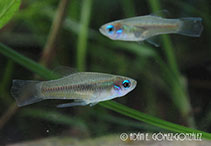 Priapella chamulae
Male Foto de Gómez González, A.E.
Fotos | Imagem do Google
Male Foto de Gómez González, A.E.
Classificação / Nomes Nomes comuns | Sinônimos | Catalog of Fishes(Gênero, Espécies) | ITIS | CoL | WoRMS | Cloffa
> Cyprinodontiformes (Rivulines, killifishes and live bearers) > Poeciliidae (Poeciliids) > Poeciliinae
Etymology: Priapella: Taken from Priapus, the Greek, and Roman god of procreation in the mithology and also = a phallus; diminutive (Ref. 45335); chamulae: Named for the native population of the Chamula, who live in central Chiapas and on the Tabasco border, Mexico.
Eponymy: This is not a true eponym as it is after Priapus, the Greek god of fertility. [...] Not a true eponym but named for a people; the native population of the Chamula, who live in central Chiapas and on the Tabasco border, Mexico. An amphibian is also named after them. (Ref. 128868), visit book page.
Etymology: Priapella: Taken from Priapus, the Greek, and Roman god of procreation in the mithology and also = a phallus; diminutive (Ref. 45335); chamulae: Named for the native population of the Chamula, who live in central Chiapas and on the Tabasco border, Mexico.
Eponymy: This is not a true eponym as it is after Priapus, the Greek god of fertility. [...] Not a true eponym but named for a people; the native population of the Chamula, who live in central Chiapas and on the Tabasco border, Mexico. An amphibian is also named after them. (Ref. 128868), visit book page.
Meio ambiente: milieu / Zona climática / intervalo de profundidade / faixa de distribuição Ecologia
; Água doce demersal. Tropical
Distribuição Territórios | Áreas da FAO | Ecossistemas | Ocorrências | Mapa de pontos | Introduções | Faunafri
North America: Mexico.
Tamanho / Peso / Idade
Descrição suscinta Chaves de identificação | Morfologia | Morfometria
Raios dorsais (total) : 9 - 10; Raios anais : 10; Vértebras: 30 - 31. This species is a large sized species of Priapella (maximum length 4.8 cm SL). It is distinguished from its congeners by having the following characters: a membranous hook of the gonopodium ray 3 well developed and semicircularly bent (vs. slightly bent in P. bonita, P. compressa, P. intermedia and P. olmecae); subdistal plate-like membranous process on gonopodium ray 3 well developed (vs. not prominent in P. compressa and P. intermedia); spines of gonopodium ray 3 long and not numerous (vs. numerous and densely crowded in P. compressa and P. intermedia) and short and not densely crowed in P. olmecae); distal part of gonopodium ray 4p slightly bent (vs. strongly bent in P. bonita, P. compressa, P. intermedia and P. olmecae). This species is also distinguished by having a short gonopodium; frequency distribution of SL/GL radius 3.30-3.50 (vs. 2.60-2.75 in P. olmecae, 3.00-3.20 in P. compressa, 2.60 in P. bonita and 3.50-3.60 in P. intermedia; gill rakers 10-12 (vs. 15-16 in P. bonita, 120-13 in P. compressa, 12-14 in P. compressa; dorsal-fin rays 9 (vs. 8 in P. bonita, 10 in P. compressa (Ref. 57748).
Collected from a small brook, about 0.5 to 1 m wide, that flows into a tributary to the río Tacotalpa, close to a bridge, a few hundred meters on an unpaved road that branches off into northeasterly direction from the main road from Tapijulapa to Jamapa between the small settlements of Zunu y Patastal and Madrigal (Cuarta sección). At the time of collection, at late afternoon the water had a temperature of 26 °C, a conductivity of 360 mS, pH 8.0, and total hardness of 10-15. The water was crystal clear and fast flowing with no aquatic vegetation. The substratum consisted mainly of gravel and sand. The brook flows in a deep indentation and is fully shadowed by the vegetation. Associated poeciliid fishes were Pseudoxiphophorus bimaculatus, Gambusia sp., Heterophallus milleri, Poecilia mexicana and a characid, Astyanax mexicanus (Ref. 57748).
Ciclo de vida ou comportamento de acasalamento Maturidade | Reprodução | Desova | Ovos | Fecundidade | Larvas
Referência principal
Carregar suas referências | Referências | Coordenador | Colaboradores
Schartl, M., M.K. Meyer and B. Wilde, 2006. Description of Priapella chamula sp. n. - a new poeciliid fish from the upper rio Grijalva system, Tabasco, Mexico (Teleostei: Cyprinodontiformes: Poeciliidae). Zoologische Abhandlung (Dresden) 55:59-67. (Ref. 57748)
Status na Lista Vermelha da UICN (Ref. 130435: Version 2025-2 (Global))
Dados insuficientes (DD) ; Date assessed: 27 March 2018
CITES
Not Evaluated
Ameaça para os humanos
Harmless
Uso pelos humanos
Pescarias: sem interesse
FAO - Publication: search | FishSource |
Mais informação
Ecologia Trófica
Itens alimentares (presas)
Composição da dieta
Consumo alimentar
Rações alimentares
Predadores
Itens alimentares (presas)
Composição da dieta
Consumo alimentar
Rações alimentares
Predadores
Dinâmica populacional
Parâmetros de crescimento
Idade máxima / tamanhos
Relação comprimento-peso.
Relação comprimento-comprimento.
Frequências de comprimento
Conversão de massa
Recrutamento
Abundância
Parâmetros de crescimento
Idade máxima / tamanhos
Relação comprimento-peso.
Relação comprimento-comprimento.
Frequências de comprimento
Conversão de massa
Recrutamento
Abundância
Ciclo de vida
Reprodução
Maturidade
Maturidade/Rel. das guelras
Fecundidade
Desova
Agregações de desova
Ovos
Desenvolvimento dos ovos
Larvas
Dinâmica larval
Reprodução
Maturidade
Maturidade/Rel. das guelras
Fecundidade
Desova
Agregações de desova
Ovos
Desenvolvimento dos ovos
Larvas
Dinâmica larval
Anatomia
Área branquial
Cérebro
Otólito
Área branquial
Cérebro
Otólito
Fisiologia
Composição corporal
Nutrientes
Consumo de oxigênio
Tipo de natação
Velocidade de natação
Pigmentos visuais
Som de peixe
Doenças e Parasitas
Toxicidade (LC50s)
Composição corporal
Nutrientes
Consumo de oxigênio
Tipo de natação
Velocidade de natação
Pigmentos visuais
Som de peixe
Doenças e Parasitas
Toxicidade (LC50s)
Genética
genoma
Genética
Heterozigosidade
Hereditariedade
Diversidade genética
genoma
Genética
Heterozigosidade
Hereditariedade
Diversidade genética
Relacionado a humanos
Sistemas de aquicultura
Perfis para aquacultura
Estirpes
Casos de Ciguatera
Selos, moedas, diversos.
Sistemas de aquicultura
Perfis para aquacultura
Estirpes
Casos de Ciguatera
Selos, moedas, diversos.
Ferramentas
Livro eletrônico | Guia de campo | Ferramenta auxiliar de frequências de comprimento | Ferramenta sobre a história de vida | Mapa de pontos |
Catch-MSY |
Relatórios especiais
Checar Manutenção em Aquário | Checar Planilhas de Fatos sobre as Espécies | Checar Planilhas de Fatos sobre Aquicultura
Baixar XML
Fontes da internet
AFORO (otoliths) | Aquatic Commons | BHL | Cloffa | Websites from users | Checar Observador de Peixes (FishWatcher) | CISTI | Catalog of Fishes: Gênero, Espécies | DiscoverLife | ECOTOX | FAO - Publication: search | Faunafri | Fishipedia | Fishtrace | GloBI | Google Books | Google Scholar | Google | IGFA World Record | OneZoom | Open Tree of Life | Otolith Atlas of Taiwan Fishes | PubMed | Reef Life Survey | Socotra Atlas | TreeBase | Árvore da vida | Wikipedia: Ir para, procura | World Records Freshwater Fishing | Zoobank | Registro zoológico
Estimativas baseadas em modelos
Índice de diversidade filogenética (Ref. 82804): PD50 = 0.5156 [Uniqueness, from 0.5 = low to 2.0 = high].
Bayesian length-weight: a=0.00851 (0.00369 - 0.01962), b=3.15 (2.96 - 3.34), in cm total length, based on LWR estimates for this (Sub)family-body shape (Ref. 93245).
Nível Trófico (Ref. 69278): 3.0 ±0.4 se; based on size and trophs of closest relatives
Resiliência (Ref. 120179): Elevada, tempo mínimo de duplicação da população menor que 15 meses (Preliminary K or Fecundity.).