



Sube tu fotos y Vídeos
Imágenes | Google image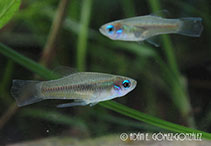 Priapella chamulae
Male Foto de Gómez González, A.E.
Imágenes | Google image
Male Foto de Gómez González, A.E.
Clasificación / Nombres Nombres comunes | Sinónimos | Catalog of Fishes(Género, Especie) | ITIS | CoL | WoRMS | Cloffa
> Cyprinodontiformes (Rivulines, killifishes and live bearers) > Poeciliidae (Poeciliids) > Poeciliinae
Etymology: Priapella: Taken from Priapus, the Greek, and Roman god of procreation in the mithology and also = a phallus; diminutive (Ref. 45335); chamulae: Named for the native population of the Chamula, who live in central Chiapas and on the Tabasco border, Mexico.
Eponymy: This is not a true eponym as it is after Priapus, the Greek god of fertility. [...] Not a true eponym but named for a people; the native population of the Chamula, who live in central Chiapas and on the Tabasco border, Mexico. An amphibian is also named after them. (Ref. 128868), visit book page.
Etymology: Priapella: Taken from Priapus, the Greek, and Roman god of procreation in the mithology and also = a phallus; diminutive (Ref. 45335); chamulae: Named for the native population of the Chamula, who live in central Chiapas and on the Tabasco border, Mexico.
Eponymy: This is not a true eponym as it is after Priapus, the Greek god of fertility. [...] Not a true eponym but named for a people; the native population of the Chamula, who live in central Chiapas and on the Tabasco border, Mexico. An amphibian is also named after them. (Ref. 128868), visit book page.
Entorno: milieu / zona climática / rango de profundidad / gama de distribución Ecología
; agua dulce demersal. Tropical
Distribución Territorios | Áreas FAO | Ecosistemas | Ocurrencias, apariciones | Mapa de puntos | Introducciones | Faunafri
North America: Mexico.
Tamaño / Peso / Edad
Descripción breve Claves de identificación | Morfología | Morfometría
Radios blandos dorsales (total) : 9 - 10; Radios blandos anales: 10; Vértebra: 30 - 31. This species is a large sized species of Priapella (maximum length 4.8 cm SL). It is distinguished from its congeners by having the following characters: a membranous hook of the gonopodium ray 3 well developed and semicircularly bent (vs. slightly bent in P. bonita, P. compressa, P. intermedia and P. olmecae); subdistal plate-like membranous process on gonopodium ray 3 well developed (vs. not prominent in P. compressa and P. intermedia); spines of gonopodium ray 3 long and not numerous (vs. numerous and densely crowded in P. compressa and P. intermedia) and short and not densely crowed in P. olmecae); distal part of gonopodium ray 4p slightly bent (vs. strongly bent in P. bonita, P. compressa, P. intermedia and P. olmecae). This species is also distinguished by having a short gonopodium; frequency distribution of SL/GL radius 3.30-3.50 (vs. 2.60-2.75 in P. olmecae, 3.00-3.20 in P. compressa, 2.60 in P. bonita and 3.50-3.60 in P. intermedia; gill rakers 10-12 (vs. 15-16 in P. bonita, 120-13 in P. compressa, 12-14 in P. compressa; dorsal-fin rays 9 (vs. 8 in P. bonita, 10 in P. compressa (Ref. 57748).
Collected from a small brook, about 0.5 to 1 m wide, that flows into a tributary to the río Tacotalpa, close to a bridge, a few hundred meters on an unpaved road that branches off into northeasterly direction from the main road from Tapijulapa to Jamapa between the small settlements of Zunu y Patastal and Madrigal (Cuarta sección). At the time of collection, at late afternoon the water had a temperature of 26 °C, a conductivity of 360 mS, pH 8.0, and total hardness of 10-15. The water was crystal clear and fast flowing with no aquatic vegetation. The substratum consisted mainly of gravel and sand. The brook flows in a deep indentation and is fully shadowed by the vegetation. Associated poeciliid fishes were Pseudoxiphophorus bimaculatus, Gambusia sp., Heterophallus milleri, Poecilia mexicana and a characid, Astyanax mexicanus (Ref. 57748).
Ciclo vital y comportamiento de apareamiento Madurez | Reproducción | Puesta | Huevos | Fecundidad | Larva
Referencia principal
Suba sus referencias | Referencias | Coordinador | Colaboradores
Schartl, M., M.K. Meyer and B. Wilde, 2006. Description of Priapella chamula sp. n. - a new poeciliid fish from the upper rio Grijalva system, Tabasco, Mexico (Teleostei: Cyprinodontiformes: Poeciliidae). Zoologische Abhandlung (Dresden) 55:59-67. (Ref. 57748)
Situación en la Lista Roja de la UICN (Ref. 130435: Version 2025-2 (Global))
Data deficient (DD) ; Date assessed: 27 March 2018
CITES
Not Evaluated
Amenaza para el ser humano
Harmless
Usos humanos
Pesquerías: sin interés
FAO - Publication: search | FishSource |
Más información
Ecología Trófica
Alimentos (presas)
Composición de la dieta
consumo de alimento
Raciones de comida
Despredadores
Alimentos (presas)
Composición de la dieta
consumo de alimento
Raciones de comida
Despredadores
Dinámica de la población
Coeficiente del crecimiento para
Edades / tallas máximas
Longitud-peso rel.
Longitud-longitud rel.
Longitud-frecuencias
Conversión de masas
Reclutamiento
Abundancia
Coeficiente del crecimiento para
Edades / tallas máximas
Longitud-peso rel.
Longitud-longitud rel.
Longitud-frecuencias
Conversión de masas
Reclutamiento
Abundancia
Ciclo de vida
Reproducción
Madurez
Madurez/Gills rel.
Fecundidad
Puesta
Agregaciones de desove
Huevos
Desarrollo de los huevos
Larva
Dinámica larvaria
Reproducción
Madurez
Madurez/Gills rel.
Fecundidad
Puesta
Agregaciones de desove
Huevos
Desarrollo de los huevos
Larva
Dinámica larvaria
Distribución
Territorios
Áreas FAO
Ecosistemas
Ocurrencias, apariciones
Introducciones
BRUVS - Vídeos
Territorios
Áreas FAO
Ecosistemas
Ocurrencias, apariciones
Introducciones
BRUVS - Vídeos
Anatomía
Superficie branquial
Cerebro
Otolito
Superficie branquial
Cerebro
Otolito
Fisiología
Composición corporal
Nutrientes
Consumo del oxígeno
Tipo de natación
Velocidad de natación
Pigmentos visuales
Sonido de peces
Enfermedades y parásitos
Toxicidad (CL50)
Composición corporal
Nutrientes
Consumo del oxígeno
Tipo de natación
Velocidad de natación
Pigmentos visuales
Sonido de peces
Enfermedades y parásitos
Toxicidad (CL50)
Genética
Genoma
Genética
Heterocigosidad
heritabilidad
Diversidad genética
Genoma
Genética
Heterocigosidad
heritabilidad
Diversidad genética
Relacionados con el ser humano
Sistemas de acuicultura
Perfiles de acuicultura
Razas
Ciguatera cases
Sellos, monedas, varios
Sistemas de acuicultura
Perfiles de acuicultura
Razas
Ciguatera cases
Sellos, monedas, varios
Herramientas
Libro electrónico | Guía de campo | Asistente para frecuencias de tallas | Herramienta de ciclo de vida | Mapa de puntos |
Catch-MSY |
Informes especiales
Comprobar el mantenimiento del acuario | Buscar fichas sobre especies | Consulte las hojas informativas sobre acuicultura
Descargar XML
Fuentes de Internet
AFORO (otoliths) | Aquatic Commons | BHL | Cloffa | Websites from users | Check FishWatcher | CISTI | Catalog of Fishes: Género, Especie | DiscoverLife | ECOTOX | FAO - Publication: search | Faunafri | Fishipedia | Fishtrace | GloBI | Google Books | Google Scholar | Google | IGFA World Record | OneZoom | Open Tree of Life | Otolith Atlas of Taiwan Fishes | PubMed | Reef Life Survey | Socotra Atlas | TreeBase | Árbol de la vida | Wikipedia: Go, búsqueda | World Records Freshwater Fishing | Zoobank | Expediente Zoológico
Estimaciones basadas en modelos
Índice de diversidad filogenética (Referencia 82804): PD50 = 0.5156 [Uniqueness, from 0.5 = low to 2.0 = high].
Bayesian length-weight: a=0.00851 (0.00369 - 0.01962), b=3.15 (2.96 - 3.34), in cm total length, based on LWR estimates for this (Sub)family-body shape (Ref. 93245).
Nivel trófico (Referencia 69278): 3.0 ±0.4 se; based on size and trophs of closest relatives
Resiliencia (Referencia 120179): Alto, población duplicada en un tiempo mínimo inferior a 15 meses (Preliminary K or Fecundity.).