



Uploaden van uw Foto's en video's
Afbeeldingen | Google afbeelding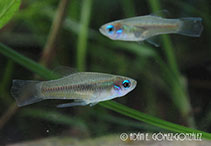 Priapella chamulae
Male Afbeelding van Gómez González, A.E.
Afbeeldingen | Google afbeelding
Male Afbeelding van Gómez González, A.E.
Classificatie / Namen Lokale namen | Synoniemen | Catalog of Fishes(Genus, Soort(en)) | ITIS | CoL | WoRMS | Cloffa
> Cyprinodontiformes (Rivulines, killifishes and live bearers) > Poeciliidae (Poeciliids) > Poeciliinae
Etymology: Priapella: Taken from Priapus, the Greek, and Roman god of procreation in the mithology and also = a phallus; diminutive (Ref. 45335); chamulae: Named for the native population of the Chamula, who live in central Chiapas and on the Tabasco border, Mexico.
Eponymy: This is not a true eponym as it is after Priapus, the Greek god of fertility. [...] Not a true eponym but named for a people; the native population of the Chamula, who live in central Chiapas and on the Tabasco border, Mexico. An amphibian is also named after them. (Ref. 128868), visit book page.
Etymology: Priapella: Taken from Priapus, the Greek, and Roman god of procreation in the mithology and also = a phallus; diminutive (Ref. 45335); chamulae: Named for the native population of the Chamula, who live in central Chiapas and on the Tabasco border, Mexico.
Eponymy: This is not a true eponym as it is after Priapus, the Greek god of fertility. [...] Not a true eponym but named for a people; the native population of the Chamula, who live in central Chiapas and on the Tabasco border, Mexico. An amphibian is also named after them. (Ref. 128868), visit book page.
Milieu: milieu / Klimaatzone / Diepte / verspreidingsgebied Ecologie
; zoet water demersaal. Tropical
Verspreiding Gebieden | FAO regio's | Ecosystemen | Voorkomen | Verspreidingskaart | Introducties | Faunafri
North America: Mexico.
Grootte / Gewicht / Leeftijd
Korte beschrijving Determinatiesleutels | Morfologie | Morfometrie
Dorsale zachte stralen (totaal) : 9 - 10; Anale zachte stralen: 10; Wervels: 30 - 31. This species is a large sized species of Priapella (maximum length 4.8 cm SL). It is distinguished from its congeners by having the following characters: a membranous hook of the gonopodium ray 3 well developed and semicircularly bent (vs. slightly bent in P. bonita, P. compressa, P. intermedia and P. olmecae); subdistal plate-like membranous process on gonopodium ray 3 well developed (vs. not prominent in P. compressa and P. intermedia); spines of gonopodium ray 3 long and not numerous (vs. numerous and densely crowded in P. compressa and P. intermedia) and short and not densely crowed in P. olmecae); distal part of gonopodium ray 4p slightly bent (vs. strongly bent in P. bonita, P. compressa, P. intermedia and P. olmecae). This species is also distinguished by having a short gonopodium; frequency distribution of SL/GL radius 3.30-3.50 (vs. 2.60-2.75 in P. olmecae, 3.00-3.20 in P. compressa, 2.60 in P. bonita and 3.50-3.60 in P. intermedia; gill rakers 10-12 (vs. 15-16 in P. bonita, 120-13 in P. compressa, 12-14 in P. compressa; dorsal-fin rays 9 (vs. 8 in P. bonita, 10 in P. compressa (Ref. 57748).
Collected from a small brook, about 0.5 to 1 m wide, that flows into a tributary to the río Tacotalpa, close to a bridge, a few hundred meters on an unpaved road that branches off into northeasterly direction from the main road from Tapijulapa to Jamapa between the small settlements of Zunu y Patastal and Madrigal (Cuarta sección). At the time of collection, at late afternoon the water had a temperature of 26 °C, a conductivity of 360 mS, pH 8.0, and total hardness of 10-15. The water was crystal clear and fast flowing with no aquatic vegetation. The substratum consisted mainly of gravel and sand. The brook flows in a deep indentation and is fully shadowed by the vegetation. Associated poeciliid fishes were Pseudoxiphophorus bimaculatus, Gambusia sp., Heterophallus milleri, Poecilia mexicana and a characid, Astyanax mexicanus (Ref. 57748).
Levenscyclus en paargedrag Maturiteit | Voortplanting | Paaien | Eieren | Fecunditeit | Larven
Hoofdreferentie
Upload uw referenties | Referenties | Coördinator | Medewerkers
Schartl, M., M.K. Meyer and B. Wilde, 2006. Description of Priapella chamula sp. n. - a new poeciliid fish from the upper rio Grijalva system, Tabasco, Mexico (Teleostei: Cyprinodontiformes: Poeciliidae). Zoologische Abhandlung (Dresden) 55:59-67. (Ref. 57748)
Status op de Rode Lijst van het IUCN (Ref. 130435: Version 2025-2 (Global))
Onvoldoende gegevens (DD) ; Date assessed: 27 March 2018
CITES
Not Evaluated
Gevaar voor de mens
Harmless
Gebruik door de mens
Visserij: van geen belang
FAO - Publication: search | FishSource |
Meer informatie
Trofische ecologie
Voedsel (prooien)
Dieetsamenstelling
Voedselconsumptie
Voedselrantsoenen
Predatoren
Voedsel (prooien)
Dieetsamenstelling
Voedselconsumptie
Voedselrantsoenen
Predatoren
Populatiedynamica
Groeiparameters
Max. leeftijden / maten
Lengte-gewicht rel.
Lengte-lengte rel.
Lengtefrequenties
Massaconversie
Rekrutering
Abundantie
Groeiparameters
Max. leeftijden / maten
Lengte-gewicht rel.
Lengte-lengte rel.
Lengtefrequenties
Massaconversie
Rekrutering
Abundantie
Levenscyclus
Voortplanting
Maturiteit
Rijpheid/kieuwen rel.
Fecunditeit
Paaien
Paaibestanden
Eieren
Ontwikkeling van de eieren
Larven
Larvale populatiedynamiek
Voortplanting
Maturiteit
Rijpheid/kieuwen rel.
Fecunditeit
Paaien
Paaibestanden
Eieren
Ontwikkeling van de eieren
Larven
Larvale populatiedynamiek
Anatomie
Kieuwoppervlak
Hersenen
Otoliet
Kieuwoppervlak
Hersenen
Otoliet
Fysiologie
Lichaamssamenstelling
Voedingsstoffen
Zuurstofverbruik
Type zwemmen
Zwemsnelheid
Visuele pigmenten
Vis geluid
Ziekten en parasieten
Toxiciteit (LC50)
Lichaamssamenstelling
Voedingsstoffen
Zuurstofverbruik
Type zwemmen
Zwemsnelheid
Visuele pigmenten
Vis geluid
Ziekten en parasieten
Toxiciteit (LC50)
Genetica
genoom
Genetica
Heterozygositeit
Erfelijkheid
Genetische diversiteit
genoom
Genetica
Heterozygositeit
Erfelijkheid
Genetische diversiteit
Menselijk gerelateerd
Aquacultuursystemen
Aquacultuurprofielen
Kweeklijnen
Ciguatera gevallen
Postzegels, munten, diversen.
Aquacultuursystemen
Aquacultuurprofielen
Kweeklijnen
Ciguatera gevallen
Postzegels, munten, diversen.
Tools
Speciale rapporten
Bekijk gegevens voor het houden in een aquarium | Bekijk Fact Sheets voor de soort | Bekijk Aquacultuur Fact Sheets
Download XML
Internetbronnen
AFORO (otoliths) | Aquatic Commons | BHL | Cloffa | Websites from users | Bekijk FishWatcher | CISTI | Catalog of Fishes: Genus, Soort(en) | DiscoverLife | ECOTOX | FAO - Publication: search | Faunafri | Fishipedia | Fishtrace | GloBI | Google Books | Google Scholar | Google | IGFA World Record | OneZoom | Open Tree of Life | Otolith Atlas of Taiwan Fishes | PubMed | Reef Life Survey | Socotra Atlas | TreeBase | Tree of Life | Wikipedia: ga naar, zoek | World Records Freshwater Fishing | Zoobank | Zoological Record
Schattingen op basis van modellen
Fylogenetische diversiteitsindex (Ref. 82804): PD50 = 0.5156 [Uniqueness, from 0.5 = low to 2.0 = high].
Bayesian length-weight: a=0.00851 (0.00369 - 0.01962), b=3.15 (2.96 - 3.34), in cm total length, based on LWR estimates for this (Sub)family-body shape (Ref. 93245).
Trofisch niveau (Ref. 69278): 3.0 ±0.4 se; based on size and trophs of closest relatives
Weerstandsvermogen (Ref. 120179): Hoog, minimale populatieverdubbelingstijd minder dan 15 maanden (Preliminary K or Fecundity.).