



Mobula mobular (Bonnaterre, 1788)
Spinetail devil ray
Ajouter votre observation dans Fish Watcher
| Native range | All suitable habitat | Point map | Year 2050 |

|
| This map was computer-generated and has not yet been reviewed. |
| Mobula mobular AquaMaps Data sources: GBIF OBIS |
Envoyez vos Photos et vidéos
Images | vidéos | Timbres, pièces de monnaie, divers | Images Google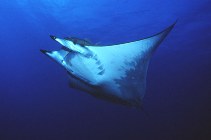 Mobula mobular
Photo de Minguell, C.
Images | vidéos | Timbres, pièces de monnaie, divers | Images Google
Photo de Minguell, C.
Classification / Noms Noms communs | Synonymes | Catalog of Fishes(Genre, Espèce) | ITIS | CoL | WoRMS | Cloffa
Élasmobranches (requins et raies) (sharks and rays) > Myliobatiformes (Stingrays) > Mobulidae (Devilrays)
More on author: Bonnaterre.
More on author: Bonnaterre.
Environnement : milieu / zone climatique / profondeur / gamme de distribution Écologie
marin pelagic-neritic; océanodrome (Ref. 51243); profondeur 0 - 700 m (Ref. 106604), usually 0 - 200 m (Ref. 89423). Subtropical; 53°N - 13°N
Distribution Territoires | Zones FAO | Écosystèmes | Occurrences | Carte par point | Introductions | Faunafri
Circumglobal.
Longueur à la première maturité / Taille / Poids / Âge
Maturité: Lm 217.8, range 204 - ? cm
Max length : 520 cm WD mâle / non sexé; (Ref. 4442); 240.0 cm WD (female); common length : 225 cm WD mâle / non sexé; (Ref. 9256); poids max. publié: 1.5 t (Ref. 115943)
Max length : 520 cm WD mâle / non sexé; (Ref. 4442); 240.0 cm WD (female); common length : 225 cm WD mâle / non sexé; (Ref. 9256); poids max. publié: 1.5 t (Ref. 115943)
Description synthétique Clés d'identification | Morphologie | Morphométrie
Larger than M. hypostoma, tail with spine and prickles (Ref. 6902).
Body shape (shape guide): other.
Body shape (shape guide): other.
An epipelagic species (Ref. 6808, 58302) found over continental shelves and near oceanic islands (Ref. 6679). Occurs singly or in groups (Ref. 9911). Feeds mainly on euphausiids (mainly Nictiphanes simplex), and to a lesser extent on copepods and crustacean larvae; also on small pelagic fishes and crustaceans (Ref. 6679, 6871), by funnelling using their cephalic fins and then trapping or filtering the food through their specialised gill plates (Ref. 115943). Acoustic tracks record the species to spend time above the thermocline at night to feed on krill (H. Dewar, pers.comm. 05/2000). Max length of female from Ref. 50641. Ovoviviparous (Ref. 50449). Bycatch mortalities have been reported from Mediterranean fisheries - large-scale driftnets, purse seines and trawls, bottom set nets, trammel nets, longlines and even fixed traps for tuna. Very common by-catch of the gillnet fisheries targeting skipjack tuna (Katsuwonus pelamis). It is utilized for its meat as protein source (except the head), its gill filter plates (of very high value and as an ingredient in Chinese medicine, Ref. 115943), its cartilage and skin (Ref. 58048).
Cycle de vie et comportement reproducteur Maturité | Reproduction | Frai | Œufs | Fécondité | Larves
Exhibit ovoviparity (aplacental viviparity), with embryos feeding initially on yolk, then receiving additional nourishment from the mother by indirect absorption of uterine fluid enriched with mucus, fat or protein through specialised structures (Ref. 6679, 50449). With one in a litter (Ref. 12951). Size at birth 85-92 cm WD (Ref. 12951, Ref. 58048).
Référence principale
Téléchargez vos références | Références | Coordinateur | Collaborateurs
McEachran, J.D. and B. Séret, 1990. Mobulidae. p. 73-76. In J.C. Quero, J.C. Hureau, C. Karrer, A. Post and L. Saldanha (eds.) Check-list of the fishes of the eastern tropical Atlantic (CLOFETA). JNICT, Lisbon; SEI, Paris; and UNESCO, Paris. Vol. 1. (Ref. 4442)
Statut dans la liste rouge de l'IUCN (Ref. 130435: Version 2025-2 (Global))
Niveau de menace critique (CR) (A2bd+3d); Date assessed: 19 June 2025
Menace pour l'homme
Harmless
Utilisations par l'homme
Pêcheries: commercial
FAO - pêcheries: débarquements; Publication: search | FishSource | Sea Around Us
Plus d'informations
Écologie trophique
Aliments (proies)
Composition du régime alimentaire
Consommation alimentaire
Rations alimentaires
Prédateurs
Aliments (proies)
Composition du régime alimentaire
Consommation alimentaire
Rations alimentaires
Prédateurs
Dynamique des populations
Paramètres de croissance
Âges / tailles maximales
Longueur-poids rel.
Rel. longueur-longueur.
Fréquences de longueurs
Conversion de masse
Recrutement
Abondance
Paramètres de croissance
Âges / tailles maximales
Longueur-poids rel.
Rel. longueur-longueur.
Fréquences de longueurs
Conversion de masse
Recrutement
Abondance
Cycle de vie
Reproduction
Maturité
Maturité/épines rel.
Fécondité
Frai
Agrégats de frai
Œufs
Développement de l'œuf
Larves
Dynamique des populations larvaires
Reproduction
Maturité
Maturité/épines rel.
Fécondité
Frai
Agrégats de frai
Œufs
Développement de l'œuf
Larves
Dynamique des populations larvaires
Physiologie
Composition corporelle
Nutriments
Consommation d'oxygène
Type de natation
Vitesse de nage
Pigments visuels
Son de poisson
Maladies et parasites
Toxicité (CL50)
Composition corporelle
Nutriments
Consommation d'oxygène
Type de natation
Vitesse de nage
Pigments visuels
Son de poisson
Maladies et parasites
Toxicité (CL50)
Liées à l'homme
Systèmes d'aquaculture
Profils d'aquaculture
Souches
Cas de ciguatera
Timbres, pièces de monnaie, divers
Systèmes d'aquaculture
Profils d'aquaculture
Souches
Cas de ciguatera
Timbres, pièces de monnaie, divers
Outils
Quiz bio | E-book | Guide de terrain | Générateur de fréquences de longueur | Outil de dynamique de population | Carte par point |
Capture-MSY |
Articles particuliers
Télécharger en XML
Sources Internet
AFORO (otoliths) | Aquatic Commons | BHL | Cloffa | Websites from users | FishWatcher | CISTI | Catalog of Fishes: Genre, Espèce | DiscoverLife | DORIS | ECOTOX | FAO - pêcheries: débarquements; Publication: search | Faunafri | Fishipedia | Fishtrace | GloBI | Google Books | Google Scholar | Google | IGFA World Record | Bases de données nationales | OneZoom | Open Tree of Life | Otolith Atlas of Taiwan Fishes | PubMed | Reef Life Survey | Socotra Atlas | TreeBase | Arbre de Vie | Wikipedia: aller à, chercher | World Records Freshwater Fishing | Zoological Record
Estimations basées sur des modèles
Température préférée (Réf. 123201): 13.1 - 23, mean 15.8 °C (based on 226 cells).
Indice de diversité phylogénétique (Réf. 82804): PD50 = 0.5020 [Uniqueness, from 0.5 = low to 2.0 = high].
Bayesian length-weight: a=0.01000 (0.00244 - 0.04107), b=3.04 (2.81 - 3.27), in cm total length, based on all LWR estimates for this body shape (Ref. 93245).
Niveau trophique (Réf. 69278): 3.5 ±0.45 se; based on food items.
Generation time: 9.2 ( na - na) years. Estimated as median ln(3)/K based on 2 growth studies.
Résilience (Réf. 120179): Faible, temps minimum de doublement de population : 4,5 à 14 années (Fec assumed to be <100).
Nutriments (Ref. 124155): Calcium = 4.56 [0.57, 78.69] mg/100g; Iron = 0.708 [0.063, 8.495] mg/100g; Protein = 21 [16, 26] %; Omega3 = 0.174 [0.053, 0.535] g/100g; Selenium = 38.5 [7.7, 213.7] μg/100g; VitaminA = 2.65 [0.21, 33.74] μg/100g; Zinc = 0.316 [0.018, 3.678] mg/100g (wet weight);