



Mobula mobular (Bonnaterre, 1788)
Spinetail devil ray
Aggiungete la vostra osservazione in Fish Watcher
| Native range | All suitable habitat | Point map | Year 2050 |

|
| This map was computer-generated and has not yet been reviewed. |
| Mobula mobular AquaMaps Data sources: GBIF OBIS |
Carica il tuo foto e Video
Immagini | Video | Francobolli, monete, materiale vario. | Google image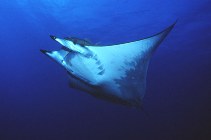 Mobula mobular
Immagine di Minguell, C.
Immagini | Video | Francobolli, monete, materiale vario. | Google image
Immagine di Minguell, C.
Classificazione / Nomi Nomi Comuni | Sinonimi | Catalog of Fishes(Genere, Specie) | ITIS | CoL | WoRMS | Cloffa
Elasmobranchi (squali e razze) (sharks and rays) > Myliobatiformes (Stingrays) > Mobulidae (Devilrays)
More on author: Bonnaterre.
More on author: Bonnaterre.
Ambiente: milieu / zona climatica / distribuzione batimetrica / gamma di distribuzione Ecologia
marino pelagic-neritic; oceanodromo (Ref. 51243); distribuzione batimetrica 0 - 700 m (Ref. 106604), usually 0 - 200 m (Ref. 89423). Subtropical; 53°N - 13°N
Distribuzione Territories | Aree FAO | Ecosistemi | Presenze | Mappa dei ritrovamenti | Introduzioni | Faunafri
Circumglobal.
Lunghezza alla prima maturità / Dimensione / Peso / Età
Maturità: Lm 217.8, range 204 - ? cm
Max length : 520 cm WD maschio/sesso non determinato; (Ref. 4442); 240.0 cm WD (female); common length : 225 cm WD maschio/sesso non determinato; (Ref. 9256); peso massimo pubblicato: 1.5 t (Ref. 115943)
Max length : 520 cm WD maschio/sesso non determinato; (Ref. 4442); 240.0 cm WD (female); common length : 225 cm WD maschio/sesso non determinato; (Ref. 9256); peso massimo pubblicato: 1.5 t (Ref. 115943)
Breve descrizione Chiavi di identificazione | Morfologia | Morfometria
Larger than M. hypostoma, tail with spine and prickles (Ref. 6902).
Body shape (shape guide): other.
Body shape (shape guide): other.
An epipelagic species (Ref. 6808, 58302) found over continental shelves and near oceanic islands (Ref. 6679). Occurs singly or in groups (Ref. 9911). Feeds mainly on euphausiids (mainly Nictiphanes simplex), and to a lesser extent on copepods and crustacean larvae; also on small pelagic fishes and crustaceans (Ref. 6679, 6871), by funnelling using their cephalic fins and then trapping or filtering the food through their specialised gill plates (Ref. 115943). Acoustic tracks record the species to spend time above the thermocline at night to feed on krill (H. Dewar, pers.comm. 05/2000). Max length of female from Ref. 50641. Ovoviviparous (Ref. 50449). Bycatch mortalities have been reported from Mediterranean fisheries - large-scale driftnets, purse seines and trawls, bottom set nets, trammel nets, longlines and even fixed traps for tuna. Very common by-catch of the gillnet fisheries targeting skipjack tuna (Katsuwonus pelamis). It is utilized for its meat as protein source (except the head), its gill filter plates (of very high value and as an ingredient in Chinese medicine, Ref. 115943), its cartilage and skin (Ref. 58048).
Ciclo vitale e comportamento di accoppiamento Maturità | Riproduzione | Deposizione | Uova | Fecondità | Larve
Exhibit ovoviparity (aplacental viviparity), with embryos feeding initially on yolk, then receiving additional nourishment from the mother by indirect absorption of uterine fluid enriched with mucus, fat or protein through specialised structures (Ref. 6679, 50449). With one in a litter (Ref. 12951). Size at birth 85-92 cm WD (Ref. 12951, Ref. 58048).
Riferimento principale
Caricare le referenze | Bibliografia | Coordinatore | Collaboratori
McEachran, J.D. and B. Séret, 1990. Mobulidae. p. 73-76. In J.C. Quero, J.C. Hureau, C. Karrer, A. Post and L. Saldanha (eds.) Check-list of the fishes of the eastern tropical Atlantic (CLOFETA). JNICT, Lisbon; SEI, Paris; and UNESCO, Paris. Vol. 1. (Ref. 4442)
Stato della Lista Rossa IUCN (Ref. 130435: Version 2025-2 (Global))
Critically Endangered (CR) (A2bd+3d); Date assessed: 19 June 2025
Minaccia per l'uomo
Harmless
Usi umani
Pesca: commerciale
FAO - pesca: sbarchi; Publication: search | FishSource | Sea Around Us
Informazioni ulteriori
Ecologia trofica
Articoli alimentari (prede)
Alimentazione
Consumo di cibo
Razioni alimentari
Predatori
Articoli alimentari (prede)
Alimentazione
Consumo di cibo
Razioni alimentari
Predatori
Dinamica della popolazione
Parametri di crescita
Età massima / dimensioni massime
Rapporto lunghezza-peso.
Lunghezza-lunghezza rel.
Lunghezza-frequenze
Conversione di massa
Reclutamento
Abbondanza
Parametri di crescita
Età massima / dimensioni massime
Rapporto lunghezza-peso.
Lunghezza-lunghezza rel.
Lunghezza-frequenze
Conversione di massa
Reclutamento
Abbondanza
Ciclo di vita
Riproduzione
Maturità
Maturità/Gli occhielli sono relativi.
Fecondità
Deposizione
Aggregazioni riproduttive
Uova
Sviluppo delle uova
Larve
Dinamica popolazioni larvali
Riproduzione
Maturità
Maturità/Gli occhielli sono relativi.
Fecondità
Deposizione
Aggregazioni riproduttive
Uova
Sviluppo delle uova
Larve
Dinamica popolazioni larvali
Fisiologia
Composizione corporea
Nutrienti
Consumo di ossigeno
Tipo di nuoto
Velocità di nuoto
Pigmenti visivi
Suono del pesce
Malattie e parassiti
Tossicità (LC50)
Composizione corporea
Nutrienti
Consumo di ossigeno
Tipo di nuoto
Velocità di nuoto
Pigmenti visivi
Suono del pesce
Malattie e parassiti
Tossicità (LC50)
Legato all'uomo
Sistemi di acquacoltura
Profili di acquacoltura
Varietà
Casi di Ciguatera
Francobolli, monete, materiale vario.
Sistemi di acquacoltura
Profili di acquacoltura
Varietà
Casi di Ciguatera
Francobolli, monete, materiale vario.
Strumenti
Quiz organico | Libro elettronico | Giuda pratica | Generatore frequenze di lunghezza | Strumento Parametri Biologici | Mappa dei ritrovamenti |
Cattura-MSY |
Rapporti speciali
Controllo della manutenzione dell'acquario | Verificare la presenza di schede informative sulle specie | Verifica delle schede informative sull'acquacoltura
Scarica XML
Fonti Internet
AFORO (otoliths) | Aquatic Commons | BHL | Cloffa | Websites from users | Check FishWatcher | CISTI | Catalog of Fishes: Genere, Specie | DiscoverLife | DORIS | ECOTOX | FAO - pesca: sbarchi; Publication: search | Faunafri | Fishipedia | Fishtrace | GloBI | Google Books | Google Scholar | Google | IGFA World Record | Database Nazionali | OneZoom | Open Tree of Life | Otolith Atlas of Taiwan Fishes | PubMed | Reef Life Survey | Socotra Atlas | TreeBase | Tree of Life | Wikipedia: Go, ricerca | World Records Freshwater Fishing | Record zoologico
Stime basate su modelli
Temperatura preferita (Fonte Biblio. 123201): 13.1 - 23, mean 15.8 °C (based on 226 cells).
Indice di diversità filogenetica (Fonte Biblio. 82804): PD50 = 0.5020 [Uniqueness, from 0.5 = low to 2.0 = high].
Bayesian length-weight: a=0.01000 (0.00244 - 0.04107), b=3.04 (2.81 - 3.27), in cm total length, based on all LWR estimates for this body shape (Ref. 93245).
Livello trofico (Fonte Biblio. 69278): 3.5 ±0.45 se; based on food items.
Generation time: 9.2 ( na - na) years. Estimated as median ln(3)/K based on 2 growth studies.
Resilienza (Fonte Biblio. 120179): Basso, tempo minimo di raddoppiamento della popolazione 4.5 - 14 anni (Fec assumed to be <100).
Nutrienti (Ref. 124155): Calcium = 4.56 [0.57, 78.69] mg/100g; Iron = 0.708 [0.063, 8.495] mg/100g; Protein = 21 [16, 26] %; Omega3 = 0.174 [0.053, 0.535] g/100g; Selenium = 38.5 [7.7, 213.7] μg/100g; VitaminA = 2.65 [0.21, 33.74] μg/100g; Zinc = 0.316 [0.018, 3.678] mg/100g (wet weight);